Different English is not wrong

Instead of seeing the way you use English as wrong, think of it as just one of many ways to use English. (A particularly awesome way, because it’s yours.)

So when you’re learning “standard” English, you’re not learning all the ways you’re wrong: you’re learning another way to communicate. Suresh Canagarajah, a professor and expert on writing, says this kind of approach

would make us perceive ESL students as expanding their repertoires rather than adding something that is missing.

Suresh Canagarajah,
“ESL Composition as a Literate Art of the Contact Zone,”
First-Year Composition

There is a world of difference in feeling like you are expanding your capabilities, as Canagarajah recommends, and feeling like you are broken and deficient and not good enough. While it might seem minor, studies have shown that a negative, stressful environment makes it harder to learn English.

Asao Inoue, another professor and writing expert, feels the same way:

This course does not consider these other Englishes as signs of being “underprepared,” “deficient,” or “lacking.”

Asao Inoue,
“A Grade-Less Writing Course,”
First-Year Composition

Then why learn “standard” or “proper” English at all? So you can use it when you want. Don’t replace your language or your English with “standard” English. As Canagarajah said, learning “standard” English expands your repertoire–the kinds of English you can use.

And there are times where “standard” English will communicate you better than your own language or your own English. As Canagarajah says,

A use of one’s repertoires without considering the dominant norms will sound naive and fail to display rhetorical sensitivity or language awareness…. [Standard Written English] is an important part of one’s repertoire

Suresh Canagarajah,
“ESL Composition as a Literate Art of the Contact Zone,”
First-Year Composition

So learn “standard” English, as another way to communicate, NOT as a way to replace your own language or English.

Embrace the Chaos

While the idea of an author sitting down and writing out a story, line by line, is nice, that’s rarely how writing works.

Writing is a messy and chaotic process. Sure, in my classes I teach the writing process, but that always comes with the caveat, “writing is a recursive process.” AKA: writing is messy.

Part of that is because writing is the intersection where thought and language crash together.

Chaos is the source of writing. Everything that will go into writing is mixed in that chaos, somewhere. And you don’t have to know what you’re going to write before you write it. 

[Proceed] without a concern for ‘thesis statements’ and all the claptrap that goes with the irrational maxim, ‘Don’t write until you know what you want to say!’ Knowing that chaos is the source is the condition of knowing how to use it .

Ann Berthoff, a big name in writing theory

How to write with the chaos

Once you accept that chaos is part of the writing process, you won’t feel so attacked when your writing is chaotic.

#175 - It’s Always Darkest Before the Dawn

Let it be.

Accept the chaos, and keep working. It may feel more and more chaotic as you write, but then, right as you are ready to give up, your writing will coalesce, come together as a nonchaotic piece of writing that just clicks.

Writing academic papers: resource roundup

Here are some of my favorite resources for writing academic papers.

Google docs. Free and simple word processor. Word and Pages are also common software, but I prefer free and easy.

My library’s website. The BEST place to start research is your library’s website, which subscribes to academic resources. Google Scholar is okay, but not my fav.

Purdue OWL. I LOVE this online writing lab, especially for citation. I use MLA most, but Purdue OWL also helps with APA, Chicago, and other obscure citation formats.

Hanging Indent Tutorial: Google Docs

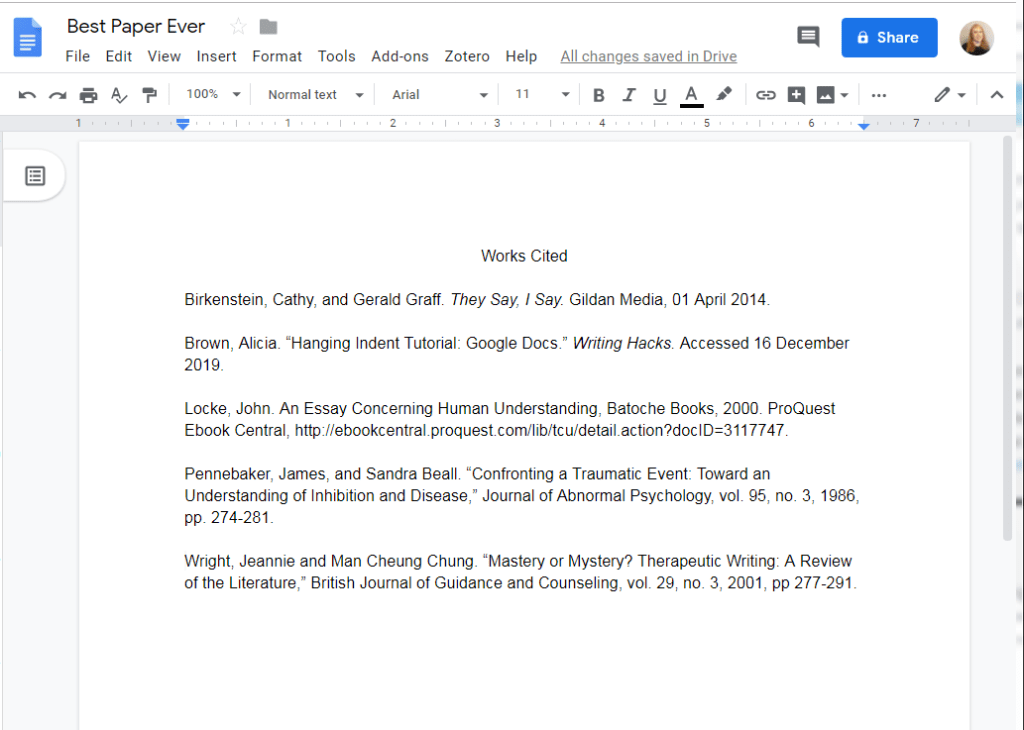
If you have to write a paper in MLA format, your last page will be a works cited page with hanging indent. My students had a difficult time making this happen, so here’s a step-by-step tutorial for you.

First, create your Works Cited Page. Purdue OWL is always a good resource for instructions.

Note: The above image is only the FIRST step. Keep going for more.

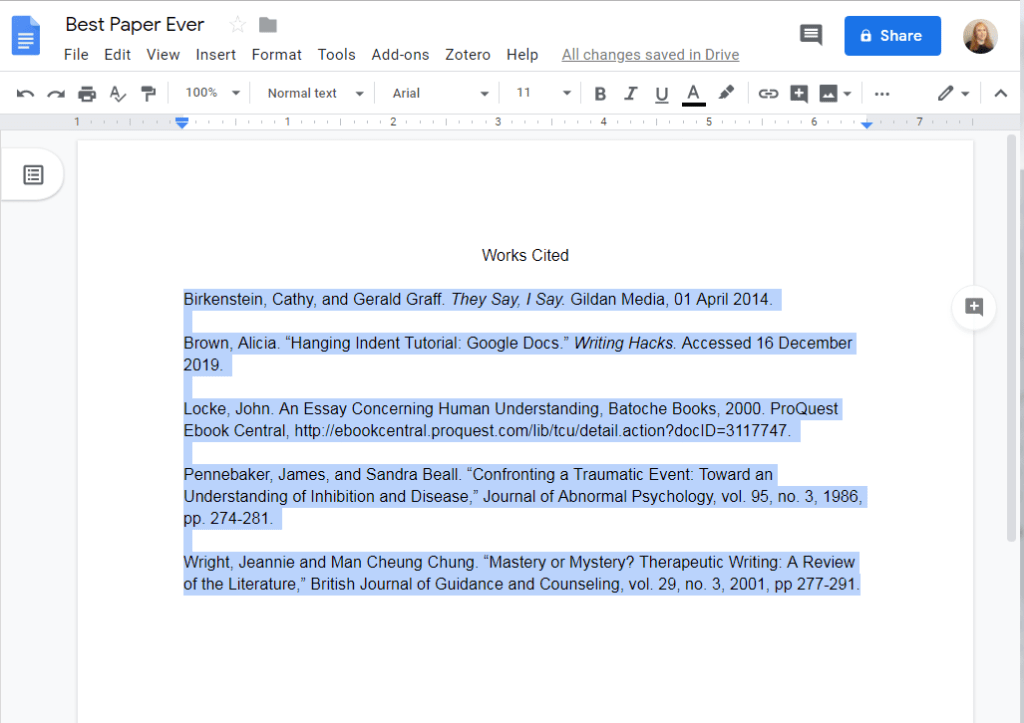
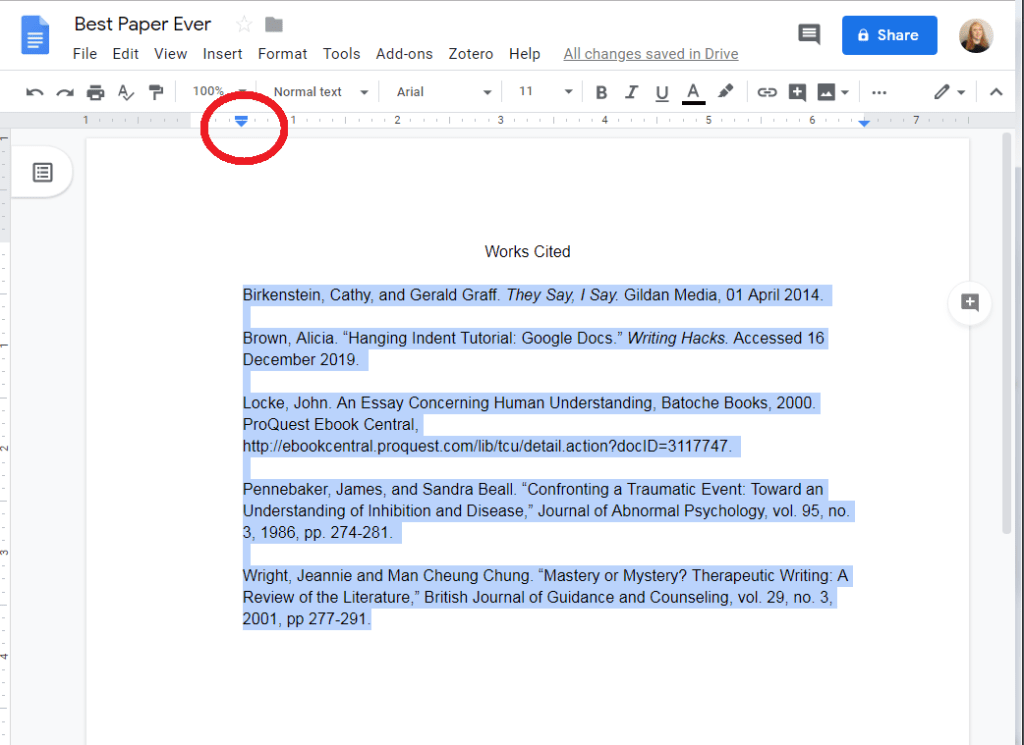
Once you have your works cited page, you need to give the entries a hanging indent. First, highlight the entries:

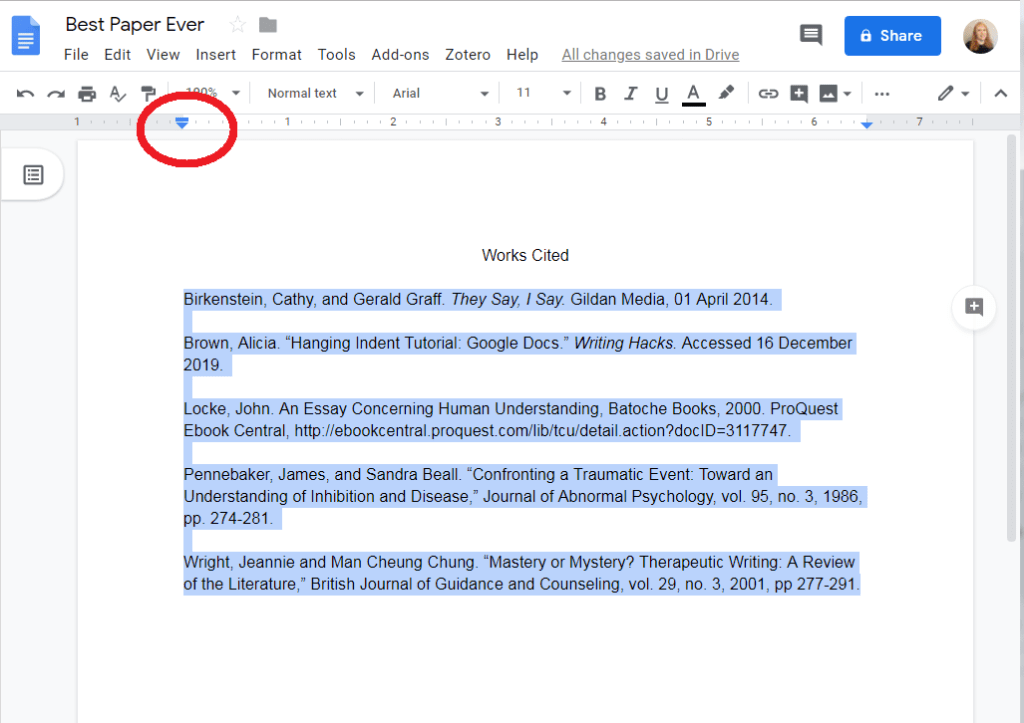
Next, click on this little doohickey on the ruler:

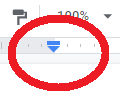
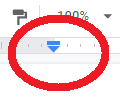
Click on the TRIANGLE part of the doohickey:

And drag it to the half inch mark (a tall line halfway between the starting point and “1”):

NOT DONE YET! Next, click on the doohickey again, but this time ONLY on the rectangle part:

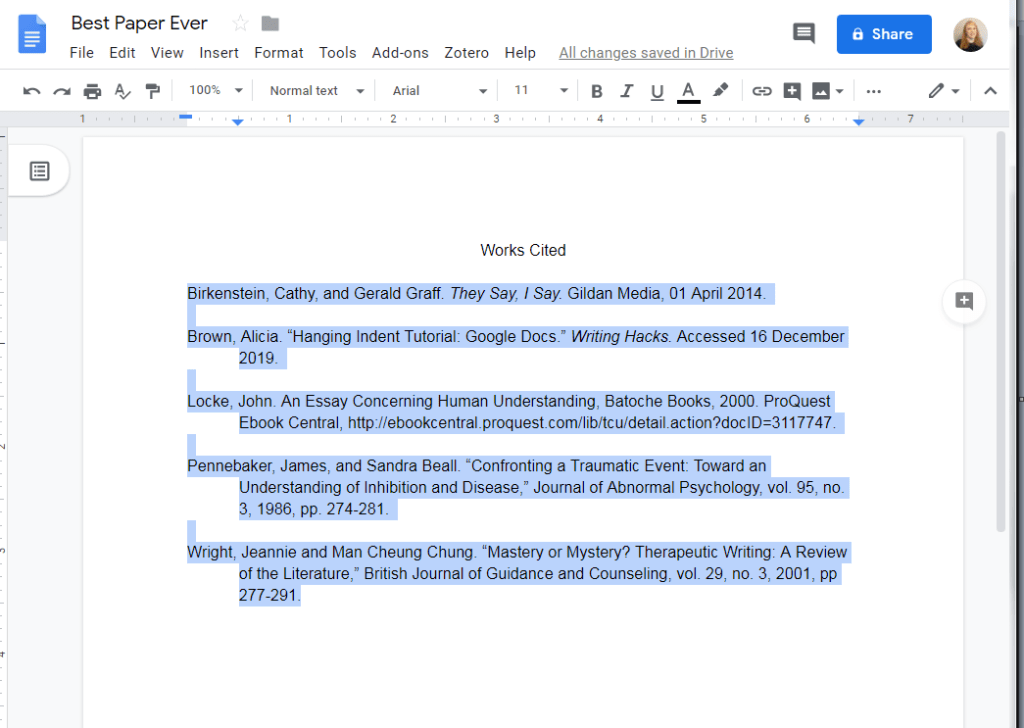
Drag the rectangle back to zero (right where the ruler turns grey). Tadaa! A beautiful hanging indent.

The Risk of Writing–and it’s not the reason you think

Writing is hard. It’s risky, too, because it is an act that exposes ourselves–who we are–to others.

Thus writing puts one at high risk, evoking great potential for anxiety. As George Herbert Mead (1962) and other social thinkers have noticed, the response of the other is central to our processes of identity formation and perception of ourselves as social actors.

Charles Bazerman

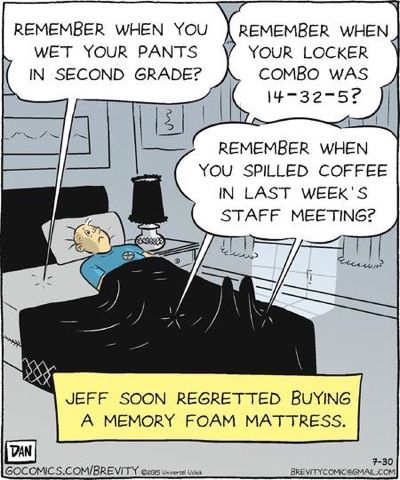
You ever lie in bed, remembering something stupid you said five years ago? Writing is like that, only it’s in your face, ALL THE TIME. Instead of just a bad memory, you can see the awkwardness of your writing, right there.

And so can everyone else. If you say something dumb, people might remember it. But if you write something dumb, people see it, read it, have it in front of them, and can criticize it a lot more than a word that disappears as soon as it’s said.

PLUS, so much of our writing is evaluated in school, and there’s nothing like a grade to create anxiety.

Thus putting ourselves “on the line” with writing creates psychological resistances, opportunities for failures of courage, backing away from our statements, insecurities and uncertainties, and general lack of clarity of thought.

Charles Bazerman

No wonder writing is so hard!

How to Fail Checklist

Failing is a part of successful writing. That’s why teachers are forever assigning drafts: rough draft, peer draft, revised draft. Even the final piece you turn in is still called a final draft.

Almost no writing is great the first time (or the second, seventh, and maybe the 23rd). Probably because there are so many moving pieces, so many aspects to consider, and our brain can only do so much at a time. So here’s how to fail so you can write better:

  • Write out your thoughts. They’ll be messy and make no sense. 
    • Misspell lots–it’s okay. 
    • Don’t worry about grammar or even complete sentences.
    • Pictures are good, too. Crappy little stick figures are my fav.
  • Now that you have SOMETHING on your page (though it fails as an essay), start looking for patterns. Move things that seem to match together.
    • Still failing! This is nothing like a good paper. Great job.
  • Need to add anything? Some research or new thoughts? Go ahead–you’re failing anyway, there’s no harm in adding things, even if they might not work.
  • Write out your thoughts in complete sentences. Your paper will still fail, don’t worry.
  • Add transitions between paragraphs.
  • Feel free to write an intro and conclusion. I never write an intro or conclusion first, often because I have no idea what I’m going to say until I say it.
  • Read your paper out loud and bask in all the mistakes you catch. More failure, yay!
  • Turn in your paper. Congratulations! You failed your way to a good paper.

Every stage except the last (and maybe still then) includes failure. And that’s okay. It’s a good thing. In their book on writing, Richard Young, Alton Becker, and Kenneth Pike talk about “the necessity of making mistakes”:

We are all reluctant to make errors, but without a willingness to make them, original inquiry is impossible. Inquiry normally proceeds by a succession of increasingly intelligent mistakes.

Rhetoric: Discovery and Change by Young, Becker, and Pike

Young, Becker, and Pike also say that false starts, hard work, and inadequate hypotheses are normal, maybe even required for innovative thought.

We Real Cool

We real cool. We
Leave school.

“We Real Cool” by Gwendolyn Brooks

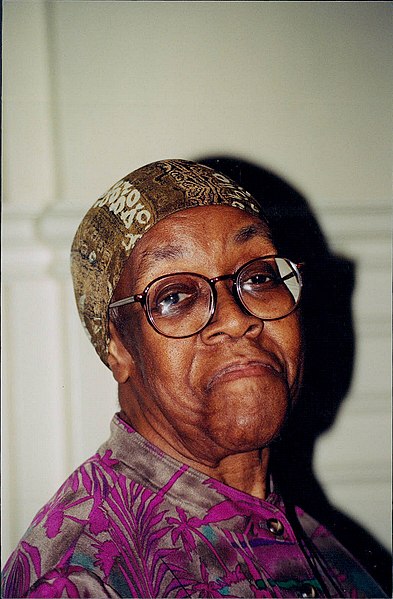
This begins Pulitzer prize winner Gwendolyn Brooks’ poem, “We real cool.” 

Just from these two lines, I can visualize the characters who said them. The way they stand, the defiant looks on their faces. Even their ethnicity.

Can you imagine if she listened to the “rules” of English and wrote, “We are cool. We skipped school today.”

All the character and interestingness drops out of the words and leaves us with nothing but “correct” grammar.